




The restructuring landscape
Restructuring in Singapore runs along a spectrum, from quiet, consensual deals to formal court-supervised processes.
At the informal end sits the consensual workout: a negotiated agreement with key creditors, without any court process. It is faster and more private, and it suits situations where creditors are few and broadly aligned.
Where a binding outcome is needed, the law offers two principal formal routes:
The scheme of arrangement
a court-sanctioned compromise that binds dissenting creditors within a class. Singapore’s scheme regime carries enhanced tools considered below.
Judicial management
under Part 7 of the IRDA, which hands the company to an independent manager behind a moratorium so that a rescue can be worked out.
For smaller companies, the Simplified Debt Restructuring Programme offers a faster, lower-cost route than a full scheme.
The tools that make restructuring work
The regime works through a set of enabling tools, several adapted from practice in other jurisdictions:
Moratorium protection.
A company proposing a scheme can apply for a court moratorium that holds off creditor action, giving it room to negotiate. Judicial management produces a similar protective effect.
Super-priority rescue financing.
The court can grant priority to new money advanced to fund a restructuring, making it possible to keep a viable business trading through the process.
Cross-class cram-down.
In defined circumstances, the court can bind a dissenting class of creditors to a scheme, so a single class cannot defeat a fair, well-supported plan.
Restriction of ipso facto clauses.
Contractual clauses that let a counterparty walk away simply because a company has entered restructuring are restricted, which protects the going-concern value on which the restructuring depends on.
Choosing a path
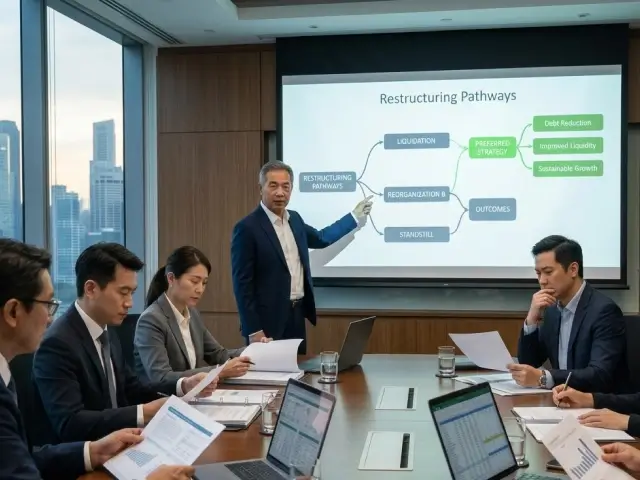
There is no single right route. A consensual workout is often the first thing to test. Where holdouts or the need for a binding deal point to a formal process, the choice between a scheme and judicial management depends on whether existing management can credibly steer the restructuring, or whether an independent manager and deeper protection are needed. International elements add another layer, addressed on our cross-border insolvency page.
How DHA+ pac approaches restructuring
DHA+ pac has worked across Singapore’s restructuring landscape since 1994. Because the firm acts in both advisory and formal appointments, we can read early whether a situation can be worked out consensually or needs a formal tool, and we design the route around the business rather than the other way round. Our restructuring and recoveries service is where this work is delivered.
FAQ
No. Many restructurings are achieved through consensual workouts without a court process. Formal routes such as a scheme or judicial management are used when a binding outcome or protection from creditors is needed.
It combines familiar formal processes with enabling tools adapted from international practice, including moratorium protection, super-priority rescue financing, cross-class cram-down, and restrictions on ipso facto clauses.
Often, yes. The main point of moratorium protection and rescue financing is to keep a viable business operating while its debts are reorganised.
Not sure where to start?
If your company is under financial pressure and you want a clear read on the restructuring options, an early conversation helps.
Contact us for a confidential review.